Showing posts with label controlling the running game. Show all posts

Friday, February 5, 2010

Conditioning is NOT a Four Letter Word

Per the request of one my college coach friends, I will be discussing the importance of being the in the best possible shape during and in preparation for a baseball season. Yes, we're talking about conditioning. To many ball players, they are more interested in simply playing the game than putting in the extra work in the gym and running and training that in is necessary to maximize the full potential of your body.

Think of it this way. Let's say you're a pretty decent pitcher with a pretty decent arm, but you don't spend a lot of time in the weight room. You actually have no idea how good your body can be at full potential because you've never played at your bodies full potential. To make matters worse, there are 1000's of players out there who are working out right now, or running sprints or running distance to give themselves every possible advantage once the up yells PLAY BALL! That's the point isn't it. To put your body in position to play harder than your opponent longer than your opponent.

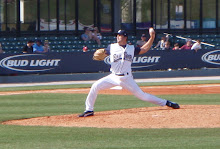
From a pitcher's stand point, your conditioning program is DIRECTLY correlated to how hard you throw, how good your arm feels, and how likely you are to get injured. Your conditioning program consists of a daily combination of the aforementioned sprints, distance running, agilities, band work, and long toss. During your preseason, you want to really build your arm strength with a dedicated long toss and bullpen program. After completing these throwing sessions, you always always always want to do some kind of running. As a good rule of thumb, after every bullpen, a nice long jog (30mins or more) is appropriate. After your long toss session, you should complete some kind of interval/sprint session.

Now, it is important that we utilize both kinds of running in conditioning program. Long runs serve a different purpose than their shorter more explosive counterparts. Longer jogs are great for pumping tons of blood through your system over a longer period of time. This blood flow helps your arm repair itself and flush out any lactic acid (the stuff that makes your arm more sore longer) build up. The runs also force the legs to strength in a long distance type of fashion which loosely mimics what is required of the body over a 2 hour pitching start. Essentially, the stronger you feel during runs, the stronger your body will feel later in the games you are pitching. On the other side, intervals and sprints are great for EXPLOSIVE leg strength. Some examples of these exercises are sprinting from the foul line to center field and walking back to the line, spring along the warning track from pole to pole (or variations of walking, jogging, and sprinting the warning track) and bow and arrows (jogging the warning track and sprinting straight across the outfield to center field). By doing these sprint workouts, we force the body to explode quickly (like the release of a baseball) and then come back to a calm state. Your heart rate will do the same thing. The elevated and the decreasing heart rate will build a different kind of endurance that will benefit a pitcher throughout each inning. Think about how your body reacts during an inning, and then the calm you experience as you wait in between innings. Ultimately, your goal is train your body to react to as many types of physical exertion as possible. If you can handle all of these types of runs, then you can handle the exertion of an outing on the mound longer and control your body better late into games.

In relation to this, you want to also conclude all of these workouts with some variation of core work. (By the way, when I say CORE WORK...I mean your full core, not just your front abs) This means planks, side planks, alligator walks, russian twists, prone cobras, ect ect. The core work is essential to controlling and stabilizing your body through these long starts we are talking about. The two main things that break down over the course of a start are your legs and your core strength. When the core breaks down, the legs will not be controlled as well and the upper half will suffer as well.


I could go on for days on this subject. Perhaps next week, we'll look even further in depth about a few specific exercises.

Until Then!!! Work hard guys, the season is almost here!!

Tuesday, January 26, 2010

The Art of the Slide-Step


Aside from throwing strikes and getting hitters out, another one of a pitcher's most important responsibilities is controlling the running game. The better job a pitcher does of preventing runners from stealing bases, the easier job he will have preventing runs from scoring that otherwise would not. There are three basic ways to do this. You can attempt a pick off move to the base the runner is occupying, you can vary your looks (checking the runner with your eyes) and timing (how long you hold the baseball before delivering it to the plate) and finally, you can be quicker than normal delivering the pitch. Most pitchers utilize some variation of a shortened leg lift called a slide-step to allow them to get to the plate without allowing the runner to get a good jump toward the base they would be stealing.

The slide-step is especially important for right handed pitchers, because they do not have the benefit of looking at the runner on first as lefties do. They must rely on changing how long they hold the ball and then being quick to the plate to give their catcher to a chance to throw the runner out. Runners steal bases by studying a pitcher's movements. Unfortunately, most pitchers are creatures of habit and have a tendency to hold the ball almost exactly the same amount of time before delivering a pitch. If they check the runner at all, they usually check the exact same time and number of times. A good base stealer will pick up on these patterns and wait until the exact moment before he lifts his leg to the plate to break for the bag.

So...the "intelligent pitcher" must be aware of these tendencies and purposefully mix up how we address the hitter. It requires repetition and practice like anything else in pitching does to be comfortable when attempting to utilize these tactics.

Mechanically speaking, to use the slide step a few things have to change. These adjustments are minor, but imperative to allow a pitcher to still remain "athletic" throughout the delivery and throw downhill without the benefit of a high leg kick that is generally used out of the wind-up. Instead of a high kick, you must bring the front knee slightly up and back towards the back leg. The hands will mimic the minor movement of the front knee, moving slightly up and back. From this position, the pitcher must be especially quick when driving the front foot down and straight toward the target. At the same, the elbows must get to the loaded and parallel position that we see out of the wind up. Usually, the arm swing must be quicker and shorter than out of the wind up, because there is less time until the front foot hits ground. The pitcher must also make sure to allow the hip turn to provide the power in the delivery, once the elbows are at their highest point.

If the pitcher is able to execute these minor adjustments, then his velocity should not suffer at all while making his delivery to the plate about 1.2 to 1.5 seconds. If the catcher is able to throw down to seconds in or around 2.0 seconds, that gives the runner only 3.5 seconds to cover 80 feet (considering he's leading off). Most runners will not be able to do this and promptly be thrown out.

So there are the basics of controlling the running game. Let me know if you have any other questions about specific scenarios!!

Until Next Time!!