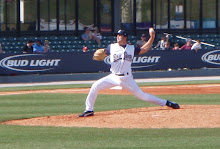
Now that many of the summer travel ball and legion seasons are coming to a close for most ball players, it is time to turn our sights on the off-season. It is a time that can truly make the difference between repeating the previous years performance or taking the next step toward achieving a ball player's dream of moving from high school to college or college to the pros. As an old sporting goods commercial used to say... " All men are created equal....some just work harder in the off season."
For the professional pitcher (i.e. any pitcher older than 12), this is the perfect time to start a dedicated long toss program. I think it is wise to take a month off to allow the arm to recover from the strain of a long spring and summer season. However, if the fall ball season starts in September or October, then we don't want to take any more than a week or two to ensure that no atrophy of the throwing muscles occur. With that in mind, we can take the extra time without actual games to get with a throwing partner and long toss atleast 3 times a week. The extended distances of the throwing and high intensity of the finish sets of a solid long toss program will allow the arm to build strength with less regard for "throwing strikes." This thought process may seem contrary to what we are trying to do (throw strikes). However, I believe that within the frame work of quality long toss (keeping head on the target, leading with the chin, not falling off to the side, the body must be trained to throw as hard as possible with out trying to throw strikes first. Then, once the velocity is increased, it must be "reigned" into the frame work of a pitching delivery.
So, take some time to get out there at least 3 times a week to begin the program. Try to increase the distance of your longest toss by about 10 feet, once a week. Be sure to mix in a solid weight lifting program and sprint/long distance cardio program. By increasing your overall physical strength in conjunction with the long toss, you can give your body the best chance to increase over all velocity, stamina, and ability repeat a delivery.
Again, this time period starting in mid August and carrying all the way into the winter is a great time to focus on building arm strength. You should try to dedicated atleast 2 solid months of long tossing 3 times a week to truly see any results. But truly, long toss should be a part of a year long throwing program. However, you wouldn't want to do it this often (3 times a week) within the season or pre-season.
If you have any questions about specific distances or actual throwing breakdowns, please comment and I will be happy to respond.
Until Next Time!
Showing posts with label pitching around. Show all posts
Showing posts with label pitching around. Show all posts
Monday, August 2, 2010


Tuesday, July 20, 2010
If You're Gonna Give 'Em Up, Make Sure They're Solo Jobs.
The enigmatic title "If You're Gonnna Give 'Em Up, Make Sure They're Solo Jobs" is a piece of advice that every pitcher should subscribe to. It refers to a pitching philosophy that revolves around keeping runners off base. In practice, it means that every pitcher is going to give up home runs, but the best ones can minimize damage and not give up as many long balls with runners on base.
I am reminded of this adage as I am watching the Orioles vs. Rays tonight on MASN. Matt Garza is on the mound for the Rays and has given up 4 home runs through 5 innings. He is also only losing 4-2. The Orioles pitcher has given up 2 home runs as well. It is not hard to imagine that this score could be much worse for both teams had those home runs not been solo shots. So, in practice, a pitcher must learn when to attack hitters and when to be careful. Of course, a pitcher must always "attack." However, early in the game and early an inning, the worst thing a pitcher can do is walk a batter. Walks and poorly placed pitches that lead to base hits are obvious things to avoid. However, this is never more true than early in those situations. With less than two outs, walking batters create more problems for the pitcher; especially if the next batter hits one out of the park.
With that in mind, if there are runners on and the game is getting into the last three or four innings, a pitcher must be careful to execute every pitch as perfectly as possible to prevent a late inning scoring onslaught. In fact, when facing a tough hitter with runners on, a good pitcher will "not give in" to a hitter by giving him a good pitch to hit. He will non-intentionally intentionally walk the batter to get a weaker hitter. He will make perfect pitches down and or just below the knees on the edges of the plate. These pitches will be so tough to hit that there is very little chance for a hitter to do damage with them. Keep in mind that this is an advanced technique that requires a very high command of ones pitches and of the strike zone. However, if executed correctly, a good pitcher can avoid giving up a mult-run hit or home run to a good hitter by making the hitter either swing at the pitcher's best pitches or be patient enough to take the walk.
The score of the game will dictate whether this strategy is a viable option. Obviously, if the score is within one run, a solo bomb is as devastating as any other home run. You would want at least a 2 run lead to begin considering putting more runners on base to get to weaker hitters.
Regardless of the situation and score however, if you are going to give up homeruns, it will always be better that they are solo shots. The less runs that score the better your ERA and your teams chance to win will be.
Until Next Time!
I am reminded of this adage as I am watching the Orioles vs. Rays tonight on MASN. Matt Garza is on the mound for the Rays and has given up 4 home runs through 5 innings. He is also only losing 4-2. The Orioles pitcher has given up 2 home runs as well. It is not hard to imagine that this score could be much worse for both teams had those home runs not been solo shots. So, in practice, a pitcher must learn when to attack hitters and when to be careful. Of course, a pitcher must always "attack." However, early in the game and early an inning, the worst thing a pitcher can do is walk a batter. Walks and poorly placed pitches that lead to base hits are obvious things to avoid. However, this is never more true than early in those situations. With less than two outs, walking batters create more problems for the pitcher; especially if the next batter hits one out of the park.
With that in mind, if there are runners on and the game is getting into the last three or four innings, a pitcher must be careful to execute every pitch as perfectly as possible to prevent a late inning scoring onslaught. In fact, when facing a tough hitter with runners on, a good pitcher will "not give in" to a hitter by giving him a good pitch to hit. He will non-intentionally intentionally walk the batter to get a weaker hitter. He will make perfect pitches down and or just below the knees on the edges of the plate. These pitches will be so tough to hit that there is very little chance for a hitter to do damage with them. Keep in mind that this is an advanced technique that requires a very high command of ones pitches and of the strike zone. However, if executed correctly, a good pitcher can avoid giving up a mult-run hit or home run to a good hitter by making the hitter either swing at the pitcher's best pitches or be patient enough to take the walk.
The score of the game will dictate whether this strategy is a viable option. Obviously, if the score is within one run, a solo bomb is as devastating as any other home run. You would want at least a 2 run lead to begin considering putting more runners on base to get to weaker hitters.
Regardless of the situation and score however, if you are going to give up homeruns, it will always be better that they are solo shots. The less runs that score the better your ERA and your teams chance to win will be.
Until Next Time!
Subscribe to:
Posts (Atom)