Sunday, December 13, 2009

Big Leaguer Breakdown: Roy Oswalt


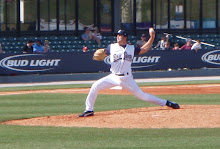
Yet another Sunday has come and gone...and Christmas is drawing near...what another great day for another Big Leaguer Breakdown. This week's subject will be Roy Oswalt for two main reasons. One, I found an outstanding slow motion video like last week's Verlander clip. And two, I think he it the best example of using your hips to draw velocity out of a smaller than average body type. Now, as the story goes with Oswalt, early in his career he had loss some of his mid-90s velocity due to some nerve impingement in his shoulder. As luck would have it however, he was working on his car one morning and was making some 'adjustments' to his car battery and was inadvertently electrocuted. Some how, through this freak accident, the impingement was alleviated and he almost immediately regained his 95mph fastball. Now, let me say, I do not condone purposefully electrocuting oneself to throw the baseball harder...I do, however, condone studying videos of Oswalt to see how he does it now.

Check out the video I am talking about of Roy Oswalt rocking and firing.


Oswalt, as I said, does not have the body type of your "prototypical" pitcher. Generally, pitchers are tall, long and lean with large powerful legs and broad backs. Oswalt on the other hand, although lean, is short and looks more like a nascar driver than a pitcher. However, lets look at the video to see how he throws his fastball in the mid-90's.

Notice immediately at the 18 second mark, that Oswalt has already begun to lock his hips and front shoulder on target. By doing so early, he has set his body in the correct position to control his hip turn until the exact right moment. Notice how both his hips and shoulder seem to lock onto target at about the same time.

One warning though, you can see as he gets his front leg to its highest point, he has already begun to leak his body weight forward. As general rule, I am not a big fan of doing so, because it generally leads to rushing by the pitcher and it usually prevents getting the elbows up on time.

If we stop the video at the 30 second mark, we see two mechanical trademarks of Roy. First off, his stride is well above average for a pitcher his size. Generally, you want your stride to be timed off your elbows getting to shoulder heights. Pushing off and trying to "jump" to the plate as Oswalt does here generally prevents good timing from the elbows. Secondly, you can see how his elbows have elevated to the power position in perfect time. His front foot hasn't quite gotten to "foot strike" but his elbows are already up and ready to begin rotating to the plate.

The next section of the video here is the most important. Rewatch the video from 30 seconds to 32 seconds and study the split second timing between his hips and his elbows. Understand that at full speed, this hip turn happens in a blink of the eye. It is almost violent to watch Roy fire his hips and bring the hand through to release point. However, it is this athleticsm that allows Roy to truly utlize every inch of power from his smaller stature. Of course, it doesn't hurt that at the 32 second mark, his chin is perfectly on target with his chest over top of his front leg with a slight bend at the knee. As we know by now, if you've read any of my other BLB's, this is essential to a pitcher being able to repeat his delivery.

So keep studying those mechanics and keep a close eye on the timing we are looking for. Oswalt is a model of that timing, even if he tends to jump a bit to his landing...this may be necessary for those vertically challenged pitchers out there.

Until next time...!!

Thursday, December 10, 2009

Throwing the Inside Change-Up


Today's topic maybe a bit on the advanced side, although the concept is quite simple. One of the most effective pitches in the game is a quality change-up. Almost every professional hitter I've discussed this with have agreed that a pitcher with a good change-up is the most frustrating. None of that should very surprising to you. But most pitchers are content with throwing their change-ups on the outer half of the plate (left handed pitchers throwing them away from righties and right handers away from lefty hitters). Problem with this is if the hitter is aware of these tendencies he can get expect and adjust to such habits.

One of the best ways to combat this dilemma is to throw change-ups on the inner half of the plate. Now understand, it takes large ........ cajones to throw this pitch. The reason is that the hitter will come out of his shoes swinging at this pitch. It will big and fat and if you miss in the middle of the plate and up, he may just hit it out of the yard. However, if it is down and in, he will either swing right through it or, more favorably hit the ball 1000 feet foul. This is because the pitch will look like a middle in fastball out of the pitcher's hand. Of course, all hitters are like sheep when they see pitches that look like fastballs in....meaning they are easily slaughtered when the pitch ISN'T a fastball.

Easily sheered sheep aside, if a pitcher can successfully execute the inner half change-up he will have added a completely new pitch and weapon to his repetoire. The hitter will have left himself completely vunerable to any number of pitches that could possibly follow the change-up. Of course, the inside change can be thrown in any count. However, I like to use it in those middle counts (1-1, 2-1, 1-0) where the hitter is looking for the fastball. He will be even more eager to swing at what looks like a fastball. What's even better, if he is thinking even more (which is always bad for a hitter...thinking mean) he may even fall victim to both the inside fastball and the inside change up following the properly executed first change.

So there you have it... the devasting effects of an inside change. Just remember, you must execute the location correctly, because, as said before, if you miss up and middle...those silly sheep will hit the ball a country mile.

Until next time

Tuesday, December 8, 2009

First Big Trade of the Off-Season


I figured today would be a good day to switch up the routine and talk about a little current events going on in the Major League off-season. In case you haven't heard, a huge trade has been announced between the Arizona Diamondbacks, New York Yankees, and Detroit Tigers has just been finalized. The moves are as follows:

Tigers get Daniel Schlereth (LHP Dbacks) and Max Scherzer (RHP Dbacks) and Austin Jackson (CF prospect from Yankees) and Phil Coke (RHP Yankees)
Yankees get Curtis Granderson (CF Tigers)
Dbacks get Ian Kennedy (RHP Yankees) and Edwin Jackson (RHP Tigers)


So, this begs the question...who got the better end of this deal?

In terms of quality pitchers, I feel the Edwin Jackson and Max Scherzer are very comparable...Jackson did have a better year this year than Max, but both have tall upsides, although I'd argue Scherzer's upside is higher.

Both Phil Coke and Ian Kennedy had high upsides at one point in their career but seemed to have plataued a bit at the Major League level.

Speaking of plateaus, Curtis Granderson definitely peaked in 2007 where he had almost a 1000 slugging percentage. His numbers have gone down since '07 but still had quite a good season this year hitting 30 HRs, stole 20 bases, and had 71 RBI's. He will def. help fill a CF void that has been empty since Bernie Williams retired.

Schlereth may well be the wild card here. He did make his Major League debut this past year with the Dbacks and showed flashes of brilliance, but also was a bit erratic at times.

All things considered, I have to give the award for "best in the trade" to the Tigers. They essentially acquired four players who could all potentially make their opening day roster. They improved didn't lose much at the starting pitching position, but got better in the bullpen with both Coke and potentially Schlereth.

Of course, the Yankees make themselves better at a crucial position without giving up a ton....they always seem to do that - however, the Tigers do seem to have come out much better as a team, whereas the Yankees supserstar pedigree makes still trade pale a bit as compared to the moves they made last year.

Finally, the Dbacks don't get a ton better or worse with the trade. I do think Jackson will fit better in Arizona and Kennedy may do better out of the Big Apple, so there is def. potential there for both guys.

Bottom line, kudos to all three teams for making moves early in the off-season. We'll see how it all plays out this coming season.


Stay tuned for more pitchign tips soon!!!

Sunday, December 6, 2009

Big Leaguer Breakdown: Justin Verlander


In my college playing career, I had the pleasure of pitching against Justin Verlander when he pitched for Old Dominion University and I was at the College of Williams & Mary. (Who, by the way, just won their second playoff football game and beat VCU in basketball....Go Tribe!) In our two starts against each other, I recorded a win, as did Verlander. Of course, he has gone on to become on of the best "hard throwing" starters in the Majors. I say "hard throwing" because it is very rare to find a pitcher such as Justin who can consistently pitch in the mid 90's and touch triple digits for a long period of time. (He has thrown that hard since college and just completed his5th big league season) Pitching for Detroit this season, Verlander went 19-9 with a 3.92 ERA. Even more impressively, he struck out 269 batters in 240 innings, both among the best in the American League. Most hard throwers "burn out" early in the season and eventually in their careers. I suppose it is still possible that Verlander will burn out, but for now he has shown an ability to maintain quality mechanics that keep his pitches sharp and velocity up. It is for these reasons, along with the personal connection that I've decided to look at Justin Verlander's mechanics in this week's Big Leaguer Breakdown.

Here's this week's video of Verlander pitching in extreme slo-mo to be looked at.

In the slo-mo video, it takes Verlander 24 seconds to get to the height of his leg lift. What you should notice is that his body weight does not shift very much from drop step, to piviot, to leg lift. The weight of his body is firmly planed on his right leg and you see very little body movement as his leg lifts to well above parallel. It requires a high amount of core strength as well as posture to maintain that body control without leaking forward.

His next movements are extremely important to notice. His leg drives straight down and Verlander almost immediately gets to his athletic position. In other words, the leg travels down before going forward with only a slight bend on the back leg. By not collapsing on the back leg, he is able to keep most of his body weight, and therefore, power in his hips and always stay taller throughout the delivery.

Verlander does tend to jump a bit to his landing. Watch the video from 27 seconds to 29 and you'll see what I mean. His foot looks as if it is about to plant and then he gains another few feet before planting. For many of my clients, this prevents them from getting on top of the ball and throw downhill. However, in this video, Verlander keeps his elbows "firing" upwards even during his 'jump.' You can tell he is getting over his front side by how bent his front knee is when it hits the ground. Although that knee does lock out on release, he is loose and flexible enough at the waist to still get over top and extend at release. Stop the video at th e31 second mark to see an absolutely perfect example of finishing over your front side with chest and chin to the target with an excellent glove turn down.

Rewatch the video from the 24 second to 31 mark and just watch his lover half. His timing is perfect with his hips leading the upperhalf to release. It is the speed of his elbows combined with the timing of his hips and height of his body at release that he is able to repeat his delivery and put serious velocity on the ball.

As always, rewatch this video and the second slo-mo video of him out of the stretch to really study his timing.

Please leave comments and/or questions......Until Next time!!

Wednesday, December 2, 2009

Why Do Pichter's Have to Run?


One of the biggest mistakes I see some of my young pitcher's make is skipping their post game or next day runs. Too many times I've heard the excuses..."But you don't really run in baseball." or "I don't run the ball to the plate, why should I work on running." Or my personal favorite, "My coach doesn't make us run, so I don't."

So here's the deal....Running is essential to becoming a better pitcher and here are three reasons why.

Firstly, legs are the foundation of a good pitching delivery. Weak legs cannot possibly repeat a pitching delivery with any kind of consistency. Therefore, running, especially sprints are essential to building explosive leg strength. Your feet, and therefore, your legs are the only part of the body that actually touch the ground. It is essential that they are as strong as possible

Secondly, running increases the overall endurance of a pitcher. This comes from quality, consistent long distance running. Think of it in terms of innings pitched. The first 10 minutes are like the first 3 innings, the next 10 minutes would be the 4th through the 6th, and the final 10 minutes represent the most important and most difficult innings in which to be sharp and effective on the mound. You that as motivation to be the pitcher who always finishes what he starts. Poor cardiovascular health will contribute to a pitcher breaking down earlier than his arm would otherwise last.

And finally and most importantly, running is essential to preventing arm injury and recovering from outings quickly and more efficiently. So here's the science behind it all. When you throw, you project your arm, shoulder, and elbow away from your body and thousands of tiny muscle fibers grip those body parts and immediately slow your arm down right after the baseball is released. When this happens repeatedly, as with pitching a game, tiny muscle fiber tears build up in the arm. To combat this, the body produces what is called "lactic acid." Recent research actually indicates that lactic acid is used by the body and burned as energy. Regardless, over time the muscles become sore. This soreness carries over and is generally worse over the following 1 to 3 days. To combat this soreness, it is essential for a pitcher to "flush" his system by getting the heart rate elevated from atleast 15 to 20 minutes. The elevated heart rate from running distance is perfect for getting more oxygen rich blood through the entire body. (In this case, any kind of cardio would suffice...swimming, biking, elliptical machine, row machine).

So, to get the best of all three running benefits, the "Intelligent Pitcher" must utilize both sprints, interval running, and distance work. I will be putting out an E-Book in the next few months to describe the perfect workout routine.

Stay tuned for more info on everything pitching...

Monday, November 30, 2009

Big Leaguer Breakdown: Dan Haren


In honor of my former team, I decided it was time to look at one of the best pitchers on the Arizona Diamondbacks, Dan Haren. Although the team struggled, Haren lead the pitching staff in almost every statistical category on his way to a stellar year with a 3.14 ERA and 14-10 Win/Loss record.


Check out this video of Dan Haren to study his motion.

The first and most obvious attribute of his delivery is his elongated pause at the top of his leg lift. This movement is very unique to Haren and possibly one or two other pitchers. It casts some light on a very important mistake that a lot of young pitchers make. They feel they must generate velocity by having a very exaggerated leg lift and jump forward to their target. However, Dan Haren's delivery is proof that you can still generate velocity (he throws in the low 90's) without gaining anything from the initial leg lift.

Let's look at the 5 second mark of the video, just after the leg lift has moved downard. You'll notice that his body is still very tall and he has not yet collapsed on the back leg. His hands have broken away from each other and the ball is well hidden behind his back. An important note should be made here, that for Haren to get back on top of the baseball and get to his 'power position' he must have a very fluid yet aggressive move to the elbows up position. Regardless, Haren at this mark has remained tall and has his front shoulder, hip, and ankle directly on target. With a few clicks of the mouse forward, we see that Haren does exactly what he needs to do. The elbows do accelerate upward to a slightly tilted power positin. Also note that before his shoulders begin to turn to throw, his hips have ALREADY fired and front foot is turned torward the target.

You'll notice at the 6 second mark that his finish is a little off center and his legs remains very stiff on the finish. I normally would not advise either of these movments, but for Haren, he's managed to repeat his delivery well enough to get on top of the ball and locate it as he wishes. He is notorious for having pinpoint control and a devasting split fingered pitch. I believe that his stiffness on the front leg has actually contributed some to finishing on top of his splitter (more on that in another post)

There's another great slow mo version of Haren pitching. Check it out to really study his mechanics.

You really see how he gets into to power position and then fires the hips at about the 1.21 mark.

I love Haren's ability to repeat his delivery and hide the baseball. More importantly, I love how he is able to generate power 100% from his hip turn and drive from the back leg.

Let that be a lesson to all the young "Intelligent Pitchers" out there. You generate no extra velocity by rushing through your leg lift.

UNTIL NEXT TIME

Friday, November 27, 2009

The PItcher's Thanksgiving Wish List


In honor of the second coolest holiday of the year (behind Christmas, of course) I decided to create a Thanksgiving list of things that all pitcher's would without a doubt be thankful for (assuming they had or possessed them). Now I've left out any performance factors here. Of course, every pitcher would be thankful for being able to throw 95 mph with super sink, but lets take a second to look at some other less obvious things a pitcher would benefit from having...and therefore be thankful. Please feel free to comment and add to his list. I'll start with the top ten!!!

1. A catcher who throws out over 50% of their runners and never misses a blocked ball.

2. A shortstop that lays out for every ball from beyond second to behind third...and hits .350.

3. A set of outfielders who consider running through outfield walls a personal hobby...and hit 25 hrs each.

4. A field crew who keeps the pitcher's mound precisely at the correct angle and the dirt at exactly the right density and dampness.

5. An umpire who loves calling both the high strike AND the low strike as well as gives 2 to 3 baseballs off the outside AND inside black.

6. Hitters who know how to hit balls right at fielders...all the time.

7. A glove (and set of reflexes) that always manage to nab that chopper up the middle...even the ones behind the back ala Cliff Lee.

8. Pine tar.

9. Really long, flexible fingers that put phenomenal spin on every pitch they throw.

And last but not least.........and I had to include one performance 'thank' because its that important.

10. The ability to throw first pitch strikes in every different way possible whenever and however he wants.


So there is it boys....The "Intelligent Pitcher's Thankful List" Please leave comments and add to the list