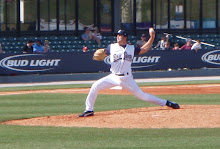
Monday, November 23, 2009

Warming Up Like a Pitcher


Today's post will concern what might be considered by some to be a pretty obvious topic. Granted the idea of "warming up like a pitcher" does seem pretty apparent. However, the actual implementation of this idea requires a little more dedication and in fact, concentration.

The idea is simple. As you are loosening your arm for a day of baseball, be it practice, a game, or just tossing with your friends, it is of great important that you take time to consider your release point and create "good muscles memory." In other words, it does the "Intelligent Pitcher" no good to toss however he pleases as he prepares for the day. I have spoken frequently, especially in our Big Leaguer Breakdowns, about the importance of certain aspects of the delivery. For example, getting the elbows up to the power position, using your hips to drive the upper half to release point, and of course, balance point. To create the positive muscle memory, we must make sure that we incorporate these movements into each throw we make. If we don't, we train our muscles to move in a way that creates poor pitching mechanics.

So, one simple way to create better muscle memory as we warm up is to focus on one part of your throwing partners body. I like to use one of my partner's shoulders as a target. I alternate each throw from side to side to better simulate throwing to both sides of the plate. It's also very important to concentrate on repeating the same arm slot with every throw you make. As you increase your throwing distance, it becomes easier to incorporate other throwing techniques as it becomes more necessary to use your hips and accelerate your hand at release point to get the ball to the target.

Give these tips a try starting with your next game of catch. Then, stay consistent with these adjustments over the course of the offseason, then by the time your season rolls around you will be able to repeat your perfect delivery without the same effort.

Until next time!!!

Saturday, November 21, 2009

Big Leaguer Breakdown: Johan Santana


As a left handed pitcher myself, I find it tremendously useful to study some of the best lefties in the game. Without a doubt, Johan Santana can make claim to that distinction based on his many years with the Minnesota Twins and last two years with the New York Mets. He throws three pitches extremely well with his power change-up being his true "out pitch." Of course, it doesn't hurt that he throws 95 mph and locates with pin-point accuracy most of the time. In fact his numbers speak for themselves. In 10 big league seasons, he has a career record of 122-60 with an ERA of 3.20. He has 1733 career strikeouts and only a 1.10 WHIP. So, as we do here at Less Is More, I've decided to analyze Johan's motion for this week's Big Leaguer Breakdown.

Check out this video of Johan warming up to get a look at how he works.


The video is of Johan working out of the stretch and at the end we have a slow motion version of his delivery so we will talk about that portion of the clip. Feel free to watch repeatedly the entire video. Examine the 44 second mark of the video, before he's even lifted his leg - it should be easy to see how tall and athletic he already looks before he even moves. Notice his hand slot as well. They are located up by his shoulder and slightly away from his body. Within the framework of his mechanics, it works extremely well because of how his hand break works. If we watch forward to the 47 second mark, Santana has lifted his leg and gotten more compact within his entire body. His hands have moved in and front leg has gotten "loaded" inward before he works forward.

The next part of his delivery is key to study. Watch as his hands breaks and his front leg works down, but also out. Johan also sinks considerably on his back leg. Typically, I would argue that this would create some problems when trying to work down hill at release. However, in Johan's case, you must notice how quickly his hand break transfer into the "elbow's up"power position. Although the front leg has swung slighty out and around, his body weight stays loaded on the back leg for a longer period of time than the average pitcher. This characteristic is key to notice, because it allows him to transfer his weight exactly at the instance of foot strike (front foot hitting the ground). Again, notice at the 50 second mark, how perfectly his elbows are align and on target. Notice also how his front hip has not yet rotated through, but is also still on contact. By keeping his weight loaded on his back leg longer (even though he does collapse a bit) he is able to truly drive his hips through and, as we all know, if the elbows are up they will follow the hits.

Go ahead and look forward to the 1 minute mark. This is Johan's second slow motion pitch. We are now at the finish of his delivery; something he does with exact replicatin each time. His head is slightly off center, but does finish with absolute athleticism over top of his front leg.

So as we can see with the video, we must be careful to stay loaded on the back leg until the elbows get to their highest point. Although Johan collapses a bit, he times up his hips perfectly with those elbows and his athletic ability allow him to get on top of the baseball and finish down.

Continue to study and make it happen as Johan does!

Until next time!!

Thursday, November 19, 2009

Look Imposing on the Mound

I've been communicating with some young pitchers lately on a forum at www.letstalkpitching.com. One of the topics asked by a high schooler was "How do intimidate hitters?" It was actually a very intelligent question from a young aspiring hurler. It certainly acknowledges that there is much more to the pitcher - hitter battle than just the pitches being thrown. Sometimes, even the pitches being thrown can and should be used to "intimidate" the hitter.

From an "Intelligent Pitcher's" perspective, we must constantly aspire to have the edge in both the mental and physical side of the contest. For starters, let's think about how we stand and look on the mound. I used to wear my socks up in high school and college. However, upon turning pro, I decided that most professional pitchers wear their pants down and that it contributes to looking taller on the mound. Trust me, the taller the pitcher looks, the less comfortable the hitter will be in the box (e.g. Randy Johnson). I am also reminded of an interview with Johan Santana where he was describing where he learned his unique style of pitching. He said that in an effort to look bigger on the mound he had to physically widen is stance on the rubber. That thought process contributed to him standing as he currently does with his feet wider than most on the mound out of the wind-up.


Here's Kruk barely missing RJ's Fastball in the 2003 Allstar Game


Secondly, I've always ascribed to the school of that a pitcher should never show emotion on the mound. It is the idea that you are in control at all times and nothing the other team, especially the hitter at the plate, can do to get into your head. I'm not a big fan of the large fist pump after strike out or big play, however, I understand there are times where some people just can't help but let a little adrenaline out. It shouldn't matter if you just recorded a strike-out or gave up a three run bomb - your mind set and countenance (sorry, thats a William and Mary word that means facial expression) should never change.

Thirdly, the pitches you make will say the most about who you are as a pitcher. Never ever be afraid to throw the baseball inside. That part of the plate is yours and will never ever be the hitter's unless you allow it to be. If a hitter gets too close, you are completely within your rights to make sure you let him know he's too close with a well placed fastball under the chin. Now understand, do not EVER throw at a hitter's head, but if you need to knock him down...do it.

Ultimately, the pitches you make and your ability to shut down the opposing hitters will make you look more imposing than anything else. However, you must constantly be striving for every advantage and these few examples will go a long way to give you the edge you are looking forward to. It's all part of the Less is More philosphy. The idea that the more prepared and in control you are, the less hard you will have to "try"to throw strikes and gets outs as it all becomes more and more natural and, well, effortless.

Until Next time!!

Tuesday, November 17, 2009

What the Heck is a Spike Curveball?

With the conclusion of the World Series and off season successfully here, I wanted to address one of the pitches that made Cliff Lee so effective this season. Many times you heard announcers describe his breaking ball as a "Spike Curveball." Well, I'll be honest with you. I had never heard the phrase before and yet, I still knew what I thought they were talking about. Upon further investigation and research, I discovered that the unique breaking ball that Mr. Lee throws is what is normally referred to as a Knuckle Curve.

Before Lee, Mike Mussina was also famous for throwing this tight spinning 12 to 6 or 11 to 5 (on the clock) breaking pitch. It gets its name as a Knuckle Curve (and also Spike Curve) because of the way the pitch is gripped. The middle finger is straight along the outer seam of the ball and the index finger is tucked underneath (similar to a knuckleball grip). I have had better success myself by sticking my fingernail directly into the seam of the ball. Either way, the knuckle is used to help accelerate the spin of the ball as it comes out of the pitchers hand by straightening the tucked finger at the release of the pitch. Typically, this will create a hard biting pitch that "spikes" downward, generally bouncing on the plate. Hence, the two reasons for the name.


The other difference between the Cliff Lee breaking ball and your average curveball is hand position at release. With a typical curve, the hand turned clockwise at release to put breaking ball spin on the ball. The benefit of the Spike Curve ball is that than hand stays up and behind the baseball until release. Instead of the quarter turn as described above, the hand rolls over at release and the knuckle finger extends, applying spin to the ball. Without the hand turn, the pitch is even more difficult to pick up. It works especially well when the spin of the ball is exactly 12 - 6 (or end over end). Most hitters are unable to tell the difference between a breaking ball spinning end over end and a fastball spinning in the exact opposite direction. The delay in pitch recognition will be all it takes to make it too late for the hitter to adjust to the breaking ball.

So there you have, the Spike Curve (Knuckle Curve) explained!

Remember to check out the new website here (if you aren't already there) and register for the free content!!

Until next time!!!!

Sunday, November 15, 2009

Big Leaguer Breakdown: Roy Halladay


Another week has come and gone and that means its time for another installment of Less Is More's Big Leaguer Breakdown. As one of the best all around pitchers of the past five years, Roy Hallady will be this week's victim. After ranking first in league in 2009 in complete games (9), third in ERA (2.79), second in IP (239), and second in WHIP (1.13), it begs to reason that much can be learned from the pitching techniques of Mr. Halladay.

Check out this video of Roy preparing for a game vs. the Orioles in 2009.

As an "Intelligent Pitcher," we understand the importance of being fluid in one's delivery and, more importantly, repeating that delivery every time. Roy Halladay does not have the most text book mechanics, but his ability to repeat that delivery has created a pitching style that allows him to release all three pitches (sinker, slider, change-up) from the exact same arm slot with the same exact arm speed.

We'll start as we normally do, at the most important point in the delivery (besides the power position), the balance point. At the 4 second mark the in the delivery, Halladay in unique as he brings his league high into his chest as it rotates inward, showing his back to the hitter. It is important to note here, that Halladay's fastball is one of the best "sinkers" in the game. Most, if not all, sinker-ballers have some sort of upper body rotation like Roy's. Revisit the BLB's of both Derek Lowe and AJ Burnette (both sinker-ballers) and you will see similar upper body rotation.

Go ahead a few clicks and the video and you will see the mechanics that contribute to the sinker. From the 5 and 6 second mark, Halladay breaks his hands out and around as his front leg does the same thing. Another keep trade mark of the "Intelligent Pitcher," is maintaining symmetry between the upper half and the lower half. Of course, as the upper and lower body rotate together, it must get to the mid-line in the delivery and finish directly at the target. Watch as the front foot hits the ground and his rotation in his hips are delivered through the upper-half and finishes with the release of the pitch. This finish is key to the sinker and Roy Halladay's deceptiveness.

It would be very difficult to throw directly overhand with the upperhalf rotation, so Roy does have a low-three quarters arm slot. Stop the video at the 15 second mark to view a second pitch and review his arm slot. His chest is over top of his front foot, and his chin is over top of his chest and pointed right at the target. In previous Big League Breakdowns, almost every pitcher has been able to get to this point in their delivery. Roy's difference is that he is able to repeat his rotation almost flawlessly where to many other's it would create timing problems.

Again, review this video and take not of how fluid he is from start to finish. Also note that although he is not direct to the target until he gets to his front foot plant position. It is his ability to finish down to the target that creates an unhittable sinker, slider, change-up. That and flawless identical hand and arm speed.


In related news...The Less Is More website will be up and running tomorrow! Check it out here!

Until next time!!

Tuesday, November 10, 2009

How to Strike Out Albert Pujols.


As one of the most prolific homerun hitters in the last decade, Albert Pujols is possibly one of the most difficult hitters to get out in all of baseball. If you'll recall, by August of this year, King Albert was 7-9 with 5 bombs and 24 RBI's with the bases juiced. What's more, he was 6-6 on first pitch counts and when he was actually behind in counts. So he becomes even more dangerous when it matters the most!

Aside from intentionally walking in a run when he comes to the plate with the bases loaded - how does the "Intelligent Pitcher" get Pujols out. I am reminded of an at bat versus the Astros' Roy Oswalt. Roy was able to strike Pujols out on three consecutive perfectly placed outside fastballs. Albert didn't swing at any of the three pitches and struck out quickly. What does this tell us about Pujols?

Well, for starters, it proves that you can't make mistakes to Pujols. The pitches were perfectly located that Oswalt used to K Big Red. They were just outside enough to look like balls, and yet they were still on the black for a strike. Sorry, I know that isn't exactly easy to do, but sometimes the truth hurts.

But more importantly, this at bat gives us serious insight into the mind of big league hitters. The best hitters in the game are where they are because they are the most disciplined and selective hitters in the world. They are not like their minor league breathren who are inclined to swing much more aggressively...especially at pitches they aren't in the zone. In essence, they "help out" the pitcher when he would otherwise end up walking them or getting into "hitter's counts." The professional hitter (e.g. Pujols) will wait and wait and wait for HIS pitch. It big be an inner half fastball, or a first pitch curveball or change up out over the dish. Usually its a pitch out over the dish that they can drive. Whatever it is, the best hitters in the game, such as Albert, are good enough to let good pitches go, even for strikes that put them in pitcher's count, to allow them to get the pitch they are looking for later in the at bat. Hitter's like Albert are good enough to fight off pitches when they are in 2-strike counts until the hitter makes the mistake. Sometimes even into multiple at bats, the best hitters will wait until they get that pitch...and when they get it......they do not miss.

So back to the Oswalt encounter. The best I can say is that either Oswalt or the catcher saw something in the way Albert was approaching his at bat that tipped him off that he was looking for something off-speed or inside. Luckily, they were correct and were smart enough to not deviate from their game plan. So, in this case, three perfectly painted fastballs down and away is all it took in this instance to get him out.

As you can tell, getting Pujols out is not an easy task. The "Intelligent Pitcher" must be on his game and intuitive enough to execute a game plan to perfection...all the while hoping Albert hasn't already thought of your game plan and is there waiting with the bases loaded.

Until next time.....

Sunday, November 8, 2009

Big Leaguer Breakdown: AJ Burnette


Well, unfortunately, I was correct in predicting the New York Yankees would claim their 27th World Series crown. I was also correct when I proclaimed that it would all come down to pitching and the Yankees had the advantage in that category as well. Since we've already looked at the mechanics of both CC Sabathia and Andy Pettitte, (two of the three starters used by the Yankees) I thought it'd be fitting to finish the trifecta by making this week's Big Leaguer Breakdown, AJ Burnette.

Check out this video on youtube of AJ Burnette pitching for the Yankees vs. the Tigers in July 2009.

The first thing to notice is the rhythm that AJ maintains throughout the entire motion. He's extremely fluid from start to finish and never rushes, never jumps, and never appears to be out of control. The "Intelligent Pitcher" should always strive to be like AJ in this aspect. It goes hand in hand with my "Less is More" philosophy.

So lets take our first look in this video at the 15 second mark. What you should notice is that Burnette's entire body has rotated inward, showing his back to the batter and effectively creating some deception in his delivery. It's important to note here that although this does hide the baseball, it also requires extreme focus to maintain a consisten release point. You can really notice this if you view AJ from behind. Watch the video a few clicks past (still on the 15 second mark) and you'll notice his hands break in a circular motion as is leg drops down and kicks out. Again, this contributes to AJ's deception and low-arm slot sinker he throws.

So how does AJ throw strikes with so much rotational movement in his delivery? Take a few more clicks on the video and notice the most important aspect of the Less is More Pitching philosphy... the elbows. His elbows explode up from his low hand break postion to an absolutely perfect "power position." His foot is just about to hit the ground and his hips have started to rotate. Notice (and this is key) his elbows have not yet cleared or opened yet. This position exemplifies how the hips (and hip turn) generate power to the arms to THROW THE BALL HARDER.

Another frame to exam is another one of my favorites. At the 29 second mark, Burnette has just released his second pitch in the sequence. Note the slight bend in his front knee and extention his throwing arm gets out over the leg. There is a significant bend at the waste that helps take the movement of his pitches closer to the pitch, so the hitter has less time to recognize and react to the pitch.

Go ahead and watch the rest of the video and study his mechanics again. His mechanics are not exactly textbook and they are defintely 'advanced' by most standards. For this reason, he does fall victim to some erratic performances from time to time. But when he is on, he is unhittable.

As always, leave comments and/or questions.

Until next time!